For sightseeing vehicles, 24V/40A and 48V/25A are common specifications in our enquiries. They describe different battery-voltage requirements, not two interchangeable charging speeds. Identify the installed battery's voltage and capacity first. Then check chemistry, charge limits, AC supply and the operating schedule before asking for a charger model.
A charger enquiry starts with the battery label
A resort operator may describe the vehicle by passenger count, route or body style. Those details help explain the application, but they do not identify the charging requirements. Send a readable battery label and the battery manufacturer's charging instructions. Include any replacement or conversion history.
Use Ah for battery capacity and A for charger current. A request for a 24V/40A charger still leaves the pack capacity unknown. A 48V/25A label does not identify the pack's maximum charging voltage. Both details matter when the supplier chooses the profile and evaluates your charging window.
What does your operation need overnight?
Give the supplier the actual parking and departure times. Include how much the vehicle is used on a normal day and whether it must return to service during breaks. A vehicle parked overnight presents a different task from one assigned to continuous shuttle runs with short stops.
Avoid a general request for “fast charging.” It can conceal the real question: whether the proposed battery and charger combination can meet a deadline under your site's supply conditions. Ask for a representative sample evaluation if that deadline determines the purchase. Do not rely on a time measured using another battery.
| Information | Why the supplier needs it |
|---|---|
| Nominal battery voltage | Selects the relevant voltage family |
| Chemistry and charging instructions | Establishes the required profile and voltage limits |
| Capacity in Ah | Helps describe the amount of charge to restore |
| Permitted current | Restricts the configurations that can be considered |
| Daily use and parking window | Defines the operating requirement |
| AC supply and interfaces | Determines actual output and integration needs |
For a campus shuttle cart charger enquiry, include the planned departure time rather than only the number of trips. If the fleet contains different batteries, separate the groups before comparing quotations. Similar passenger vehicles may have different electrical systems.
Use the catalogue to shortlist, not to approve compatibility
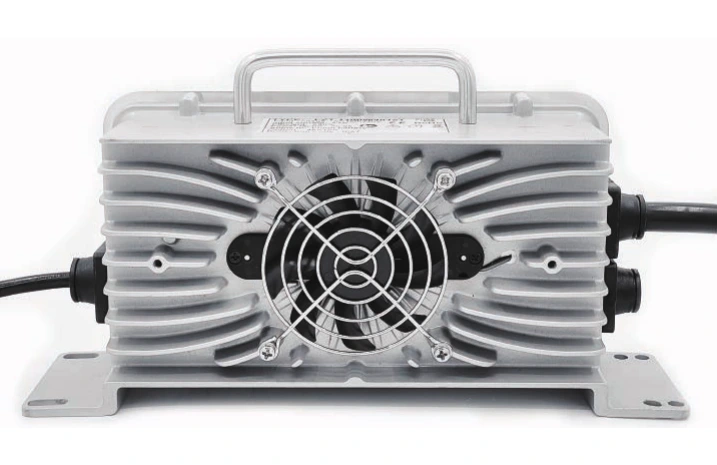
The supplied catalogue lists LZT1000W1240T with a 24V/40A designation and LZT1500W4825T with a 48V/25A designation. These rows are useful candidates to discuss for the respective requests. They do not prove that the products match a specific vehicle, battery or connector.
The 24V/40A row lists a 29.4V reference output, while the 48V/25A row lists 58.4V. Those reference voltages are not universal settings for all 24V or 48V batteries. Ask for a chemistry-specific charge profile and confirmed model datasheet. Do not apply the values to a lead-acid pack or another lithium configuration without battery approval.
The 1500W row also lists different output currents at its 220V and 110V reference inputs: 25A and 22A. That matters if the fleet uses a lower-voltage supply. Obtain the output rating at the actual installation voltage and frequency, rather than assuming the name's current is available everywhere. See the AC-input and output-current guide for this distinction.
Keep golf cart and sightseeing requests separate
Our common golf cart requests are 36V/18A and 48V/15A. That does not mean every golf cart uses those specifications, nor that sightseeing vehicles always need more current. It means the enquiry should identify the real battery instead of grouping all passenger carts together.
Terms can also vary between buyers. Someone searching for a tour bus battery charger may mean a small electric sightseeing vehicle, while another means a much larger bus system. Clarify the vehicle and battery. This article does not establish a solution for full-size electric bus charging infrastructure.
An electric sightseeing car charger also needs the complete interface checked. Provide connector markings, pinout, polarity and any enable, interlock or BMS requirements. A connector that fits mechanically is not sufficient. Qualified personnel should handle electrical integration using the manufacturer's instructions.
Make daily handling part of the order
Specify whether charging is on-board or external. For installed units, request dimensions, orientation and cooling requirements. For external units, consider where staff will place and store them, how cables will be managed and how approved configurations will be identified.
Include the intended environment in the supplier discussion. A weather-resistant housing does not establish that the entire connection can be left exposed or that a unit can operate in a tightly enclosed compartment. Ask for the exact installation and model-rating documentation.
Prepare the fleet quotation by configuration
Send battery voltage, Ah, chemistry, permitted charge limits, vehicle details, AC supply, interface information and the available charging window. State quantities separately for each battery group. Request the exact model, profile, connector drawing and AC version in the quotation.
Review the golf cart and sightseeing vehicle requirements page. Current industrial-line MOQ is 30 units; branding labels start from 200 units, subject to artwork confirmation. Typical production is approximately 15-30 days depending on quantity and customization. Confirm the schedule and add shipping time separately.
Questions buyers ask
Is 24V/40A faster than 48V/25A?
They serve different nominal-voltage systems. Charging time depends on the battery and actual charging behavior; compare approved combinations, not the amperage numbers alone.
Can catalogue reference voltage be used as a battery setting?
Only after the battery requirements and exact profile are confirmed. It is not a universal setting.
Can one charger serve every sightseeing vehicle in a fleet?
Only if every battery and interface combination is explicitly verified. Do not assume compatibility from similar vehicle bodies.
Request a charger configuration review
Send the battery voltage, capacity in Ah, chemistry, charging limits, AC supply and interface details.
Send your requirements