CAN communication allows a charger and battery management system to exchange information according to an agreed protocol. Having CAN hardware on both devices does not prove they understand each other. Before buying, confirm the protocol, connector definition, commands and fault behavior for the exact charger and BMS versions.
The question behind “Does it support CAN?”
A buyer may have a lithium pack with a CAN connection and assume that any CAN bus battery charger will work. The missing detail is the language the devices use. They need compatible message definitions and operating behavior, not merely the same type of communication interface.
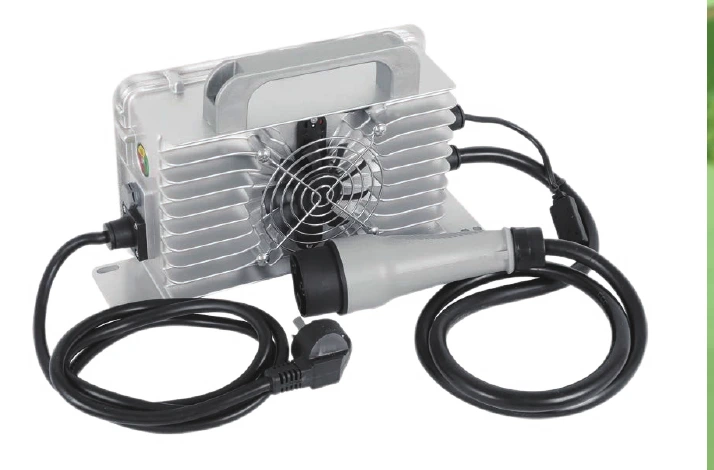
The supplied LZT2200W catalogue explicitly lists CAN communication as optional. That means it must be specified in the enquiry and confirmed for the delivered configuration. It does not establish support for a particular battery brand or BMS protocol.
First establish whether communication is required
Ask the battery manufacturer how charging is controlled. Some packs accept an approved profile without a digital link; others require communication or an enable signal. Do not add CAN merely because it sounds more advanced, and do not omit it when the battery requires it.
Supply battery voltage, capacity in Ah, chemistry, permitted charge limits and BMS identity. These remain necessary even when the pack communicates its requests. Digital control does not remove the charger's hardware limits or make every battery voltage acceptable.
For our high-speed motorcycle enquiries, common requests include 60V/20A and 48V/35A. Their requested voltage/current does not establish whether CAN is available or required. Confirm that separately for the selected hardware and pack. The same principle applies to golf carts, sightseeing vehicles and material-handling equipment.
Ask both suppliers for the same integration information
| Integration item | What needs agreement |
|---|---|
| Hardware interface | Connector allocation and supported electrical interface |
| Communication settings | Required bus settings and installation requirements |
| Message definitions | Identifiers, data meaning, units and message timing |
| Charging requests | How permitted voltage/current and enable commands are handled |
| Fault handling | How stop requests and relevant battery faults are treated |
| Communication loss | Documented behavior if required messages stop |
| Version identity | Charger firmware/profile and BMS protocol revision |
This is a procurement checklist, not a wiring recipe. Obtain the actual manufacturer's pinout and integration instructions. Bus wiring and other electrical integration should be handled by qualified personnel. Do not use assumed pins or values from an unrelated product.
A protocol name needs a revision behind it
Ask which protocol version the charger supports and whether the BMS supplier has provided the corresponding document. If one party says “standard CAN,” request the actual definition. A general interface name is not enough to freeze a production configuration.
Clarify who takes responsibility for protocol matching. If changes are required, request the development scope, deliverables and acceptance plan. Do not treat a supplier's configurable product description as a promise of free custom firmware or automatic support for any BMS.
The phrase canbus lithium charger is useful for describing the enquiry, but the purchase order needs exact identities. Record the charger model, firmware, battery/BMS model and approved protocol revision. Without those, a later replacement may look identical while behaving differently.
Define what happens when charging must stop
Normal operation is only one part of compatibility. Ask how the proposed combination handles battery requests to reduce or stop current, faults and communication loss. The required behavior should come from the battery and system specifications, not a generic assumption that every CAN charger stops in the same way.
Plan acceptance with the supplier and qualified integration personnel. Use a controlled procedure within the equipment's limits; do not provoke unsafe battery conditions to test a feature. Request records showing which versions and conditions were evaluated. A video of an indicator lighting up does not demonstrate the complete integration.
Also check any non-CAN controls, such as enable or interlock arrangements. They may form part of the system even when a digital link is present. Do not bypass them to obtain a successful demonstration.
CAN and RS485 are separate enquiries
A search for an rs485 battery charger should not be redirected into an assumption that CAN is an equivalent option. They are different interfaces, and either still needs a compatible protocol. If the pack uses RS485, ask for the exact supported hardware and protocol; the current catalogue review does not establish universal RS485 availability.
Similarly, Bluetooth adjustment and CAN battery control serve different purposes. An app that changes settings does not prove that the charger responds to BMS messages. Specify the function you need before choosing an option.
Freeze the accepted combination before the batch order
Keep the accepted protocol documents, connector drawing, profile and version list with the sample approval. Require notice when hardware or firmware changes. If the pack supplier changes the BMS, review the integration again rather than assuming the charger approval transfers unchanged.
For a quotation, send the battery/BMS specification, protocol document, required controls, AC supply, interface information and quantity. Use the industrial charger enquiry page, and refer to the forklift replacement checklist where the application requires it.
Current industrial-line MOQ is 30 units; branding labels are available from 200 units, subject to artwork confirmation. Typical production is approximately 15-30 days depending on quantity and customization. Confirm any integration work and sample approval schedule separately; shipping is additional.
Questions buyers ask
If both devices have CAN, are they compatible?
Not necessarily. Hardware interface, protocol, commands and operating behavior must be matched.
Is optional CAN included in every unit?
No assumption should be made. Specify the option and confirm the exact delivered configuration.
Does Bluetooth replace the BMS link?
No. Check the actual functions. App adjustment does not establish support for battery-control communication.
Request a charger configuration review
Send the battery voltage, capacity in Ah, chemistry, charging limits, AC supply and interface details.
Send your requirementsRelated industrial charger guides
- Onboard vs Offboard Battery Chargers: Which Setup Fits Your Vehicle?
- Bluetooth Adjustable Battery Chargers: What Dealers Should Check Before Buying
- Sightseeing Vehicle Battery Chargers: Choosing Between 24V 40A and 48V 25A Requests
- Fan-Cooled Battery Charger Installation: Space, Dust and Service Access