A charger can fit inside a compartment and still have an unsuitable installation. Fan access, surrounding heat, dust exposure and service space all matter. Before ordering a fan-cooled battery charger, request the exact mounting and cooling instructions. Do not assume that a sealed or waterproof housing can operate in any enclosed location.
What can a product photo tell you?
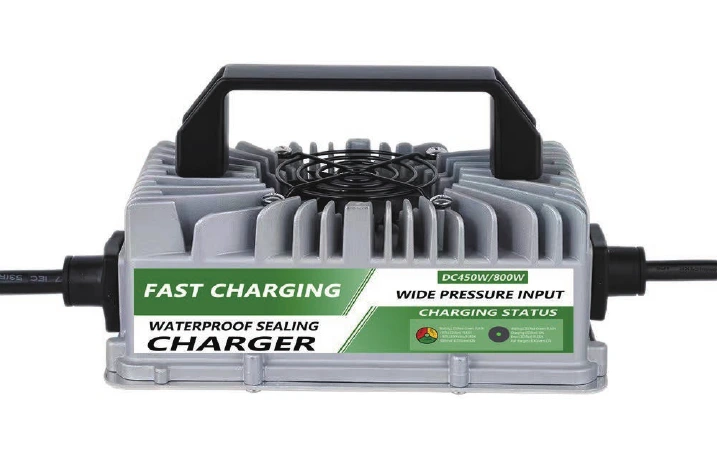
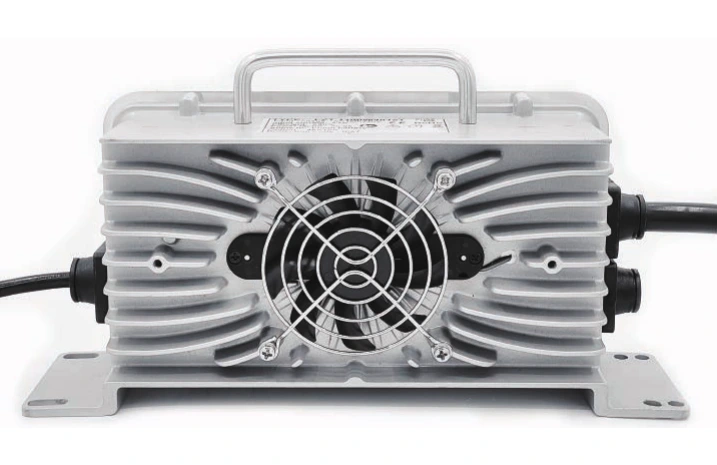
The catalogue shows several fan-cooled housings with different physical arrangements. The LZT600W/800W presentation shows a fan on the upper face, while the LZT1500W image shows a prominent fan on the front. These visible differences help buyers ask about access and placement.
They do not establish airflow direction, required spacing or the permissible installation angle. Those details need the exact manufacturer's drawing or manual. A product photograph should help frame the question, not become an improvised installation instruction.
Why a location that looks tidy can cause problems
A buyer may want to hide the charger beneath a seat or inside a storage compartment. The supplier needs to know whether that space meets the unit's requirements during charging. Nearby equipment, covers and cable bundles can change the available space and surrounding temperature.
Describe the actual arrangement. Ask whether the unit supports it, what output is available under those conditions and which restrictions apply. Do not give a clearance dimension copied from another charger family. Even similar-looking housings can have different installation instructions.
| Installation item | What to request or document |
|---|---|
| Orientation | Approved directions and fixing method |
| Cooling space | Model-specific clearances and restrictions |
| Ambient conditions | Permitted operating range and derating information |
| Exposure | Dust, moisture, cleaning and storage requirements |
| Cable route | Approved bend, support and connector-access requirements |
| Service access | Inspection and maintenance instructions for the exact unit |
The electrical match still comes first: battery voltage, capacity, chemistry and permitted charge current. A better mounting position cannot make an incorrect charge profile acceptable. Choose the configuration and installation together rather than approving the hardware first and finding a space later.
Waterproofing and cooling answer different questions
A search for a waterproof battery charger often reflects a reasonable concern about outdoor or cleaning exposure. It does not answer how the charger should dissipate heat. Likewise, a sealed battery charger description does not establish that the whole installation is sealed or free from maintenance needs.
Request the exact model's enclosure rating, tested configuration and installation conditions. Check whether the stated scope includes connectors and cable assemblies. Do not infer immersion, pressure-washing tolerance or operation in a closed compartment from the marketing description. The IP-rating purchasing checklist covers those document questions separately.
If a supplier lists several protection ratings for a family, ask which version is being quoted. Avoid putting a single family-wide rating into the purchase order unless the supplier confirms it applies to the selected configuration.
Plan for dust and cleaning without inventing a maintenance routine
Specify the intended environment: a sheltered charging area, a vehicle-mounted compartment or a dusty worksite can raise different questions. Ask the manufacturer how inspections and cleaning should be handled. Do not prescribe compressed air, washing or disassembly without instructions for the exact product.
Arrange inspection only with the equipment safely isolated in accordance with the manual. If the housing, fan guard, cable or connector is damaged, use qualified service. Do not open a mains-powered charger or reach into a fan as part of an informal check.
For external chargers, storage matters too. Ask how to protect the unit and cables when it is not in use. Do not treat a product's handle as approval to carry it while connected or to operate it inside a carrying case.
Evaluate the installation at the intended workload
A short bench demonstration is not enough if the industrial battery charger will operate for an extended charging cycle in a compartment. Agree a representative assessment using the approved battery, AC supply and installation arrangement. Qualified personnel should carry out the evaluation within the manufacturer's limits.
Request records of the conditions and any observed current changes. Do not assume every reduction means a fault, or that every fan must run continuously; the supplier should explain the exact control and derating behavior. The acceptance criteria should be agreed before evaluation.
Keep photos and drawings of the accepted installation with the sample record. If a mounting location, cover or nearby heat source changes later, review whether the approval still applies. This makes after-sales support more useful than a photograph of the charger alone.
Send the location as well as the battery details
For a quotation, send battery voltage and Ah, chemistry, current limits, AC supply, intended mounting space, surrounding conditions and clear photos. Ask for dimensions, orientation, cooling requirements and maintenance instructions for the exact model. Start with the industrial charger enquiry page.
Current industrial-line terms are MOQ 30 units, branding labels from 200 units subject to artwork confirmation, and approximately 15-30 days production depending on quantity and customization. Installation assessment and shipping should be planned separately from that production estimate.
Questions buyers ask
How much space should I leave around the fan?
Use the exact model's installation requirements. We do not infer a universal distance from catalogue photos.
Does a waterproof rating eliminate ventilation requirements?
No. Confirm both the environmental rating and the cooling requirements for the intended installation.
Can I copy the mounting arrangement from a similar-looking charger?
Not without confirmation. Obtain the drawing and instructions for the configuration being ordered.
Request a charger configuration review
Send the battery voltage, capacity in Ah, chemistry, charging limits, AC supply and interface details.
Send your requirements