A Bluetooth adjustable charger can be useful when a dealer needs controlled access to approved settings. It does not turn one charger into a safe match for every battery. Before buying, establish which battery profiles the exact version supports, who can change them and how the final configuration will be recorded for the customer.
What the catalogue tells us, and what it does not
The supplier catalogue presents an LZT1200W standard version and a Bluetooth BT version. It lists an app interface and voltage/current adjustment for the BT version, with lithium and lead-acid adjustment references. That is a reason to request the version-specific manual and a demonstration. It is not evidence of unlimited adjustment or compatibility with every pack.
We do not show an invented app screen. For a purchasing review, a real screenshot with its software version and explanation is more useful than an attractive mock-up. Ask the supplier to show the same interface that your staff or customer will receive.
Will adjustment actually reduce the number of SKUs?
A programmable battery charger may support several approved settings within one hardware configuration. That could help a dealer, but only if those settings cover the actual batteries being sold. Begin with a list of pack models, nominal voltage, capacity, chemistry and permitted charging conditions.
Different connectors, AC versions, power limits and BMS requirements can still require separate configurations. Adjustable current cannot create missing communication hardware or make an unsuitable connector acceptable. Do not calculate an inventory saving until the supplier has mapped each battery to an approved version.
| Procurement question | Evidence to request | Why it matters |
|---|---|---|
| What can be adjusted? | Version-specific ranges, increments and restrictions | Prevents “adjustable” being treated as unlimited |
| Which profiles are approved? | Battery/profile mapping and supplier instructions | Separates a permitted profile from an arbitrary setting |
| Who can make changes? | Access roles or the actual available controls | Helps plan dealer and customer responsibilities |
| What happens after a change? | Documented save, restart and status behavior | Prevents uncertainty about the active configuration |
| How is support handled? | Manual, software version and support process | Makes remote after-sales discussions practical |
Ask about profiles, not just voltage sliders
The nominal voltage printed on a battery is not its complete charging specification. A safe profile may include voltage limits, current behavior, termination and temperature-related restrictions. A “lithium” menu label is not enough to identify the correct profile for a particular chemistry and cell configuration.
Ask how the supplier defines and approves profiles. If a dealer requires a custom voltage battery charger, provide the battery manufacturer's requirements and request a controlled configuration. Do not ask staff to find a workable setting by trial and error. Adjustment should remain within documented hardware and battery limits.
Also clarify whether a field adjustment changes only a current limit or other parts of the charging behavior. The answer matters when comparing a standard unit with a BT version. A lower current setting does not necessarily solve an incorrect voltage profile or an unsupported BMS interface.
Decide who should have access
Ask whether the actual software offers restrictions, authorization or configuration locking. Do not assume those features exist simply because the product has Bluetooth. If they are absent, decide whether the product is suitable for the intended customer and how approved settings will be controlled.
A dealer-service tool and an end-user feature have different support needs. Staff may need training and configuration records. Customers need clear instructions about permitted actions and when to contact the dealer. Do not publish a charging-settings tutorial without exact model instructions and battery approval.
For connected software, also ask about supported phone platforms, connectivity requirements, update delivery and the process if the app becomes unavailable. These are purchasing questions, not claims about how the current product works. Bluetooth functionality also needs to be included in the destination-market compliance review.
Make the approved setting traceable
After a sample is approved, record hardware model, software version, battery model, profile and any approved adjustment limits. Ask how staff can read or export the active settings. If the interface does not provide that facility, agree another documented method with the supplier.
Include a check of what the unit does after normal power cycling and what information it displays. Arrange any fault or communication-loss evaluation with qualified personnel and an agreed procedure. The goal is to understand supported behavior, not to deliberately operate outside the battery's limits.
A replacement order should reproduce the accepted configuration. “Same smart battery charger as last time” is too vague if firmware, profiles or connectors can change. Keep those details on the sample record and purchase order.
Before requesting a batch quotation
Send the intended battery list, AC supply, interfaces, desired adjustment purpose and who will use the app. Ask for a comparison between the standard and BT versions that separates hardware, supported profiles and software functions. Review battery-based motorcycle charger selection if that is your application.
Use the industrial charger enquiry page to request the exact configuration. Current MOQ is 30 units. Branding labels are available from 200 units, subject to artwork confirmation. Typical production is approximately 15-30 days depending on quantity and customization, with shipping additional. Logo labels do not imply custom app or firmware development.
Questions buyers ask
Can Bluetooth adjustment make a charger work with every lithium battery?
No. Hardware capability, approved charge profile, interface and BMS requirements still apply.
Is the BT version identifiable from the product photo?
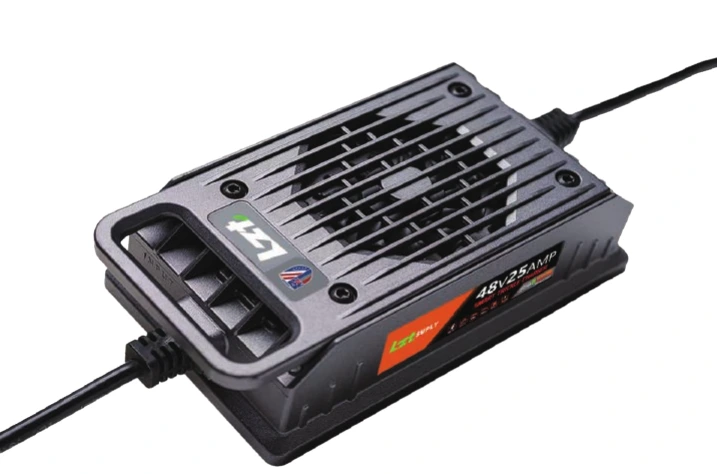
Do not rely on appearance. Confirm the exact model, label, software and functions in the quotation.
Should customers be allowed to change all settings?
That depends on the supported controls and intended use. Obtain the manual, define permitted actions and avoid uncontrolled changes to charging parameters.
Request a charger configuration review
Send the battery voltage, capacity in Ah, chemistry, charging limits, AC supply and interface details.
Send your requirements